> For the complete documentation index, see [llms.txt](https://enercalc.com/docs/llms.txt). Markdown versions of documentation pages are available by appending `.md` to page URLs; this page is available as [Markdown](https://enercalc.com/docs/e3d-user-manual/readme.md).

# ENERCALC 3D User Manual

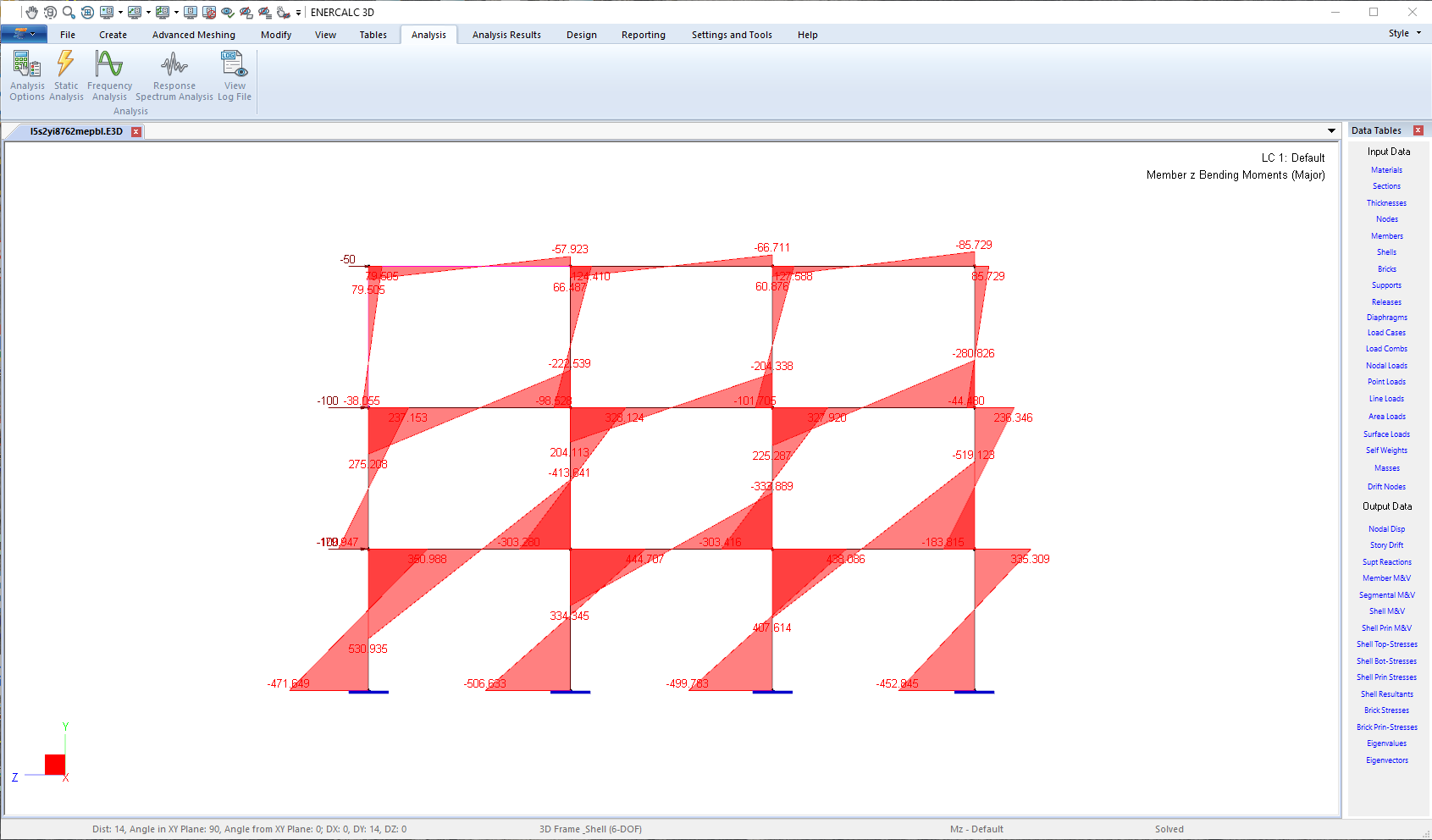
Overview of ENERCALC 3D structural analysis and design in ENERCALC SEL.

<img src="https://560001759-files.gitbook.io/~/files/v0/b/gitbook-x-prod.appspot.com/o/spaces%2FWNe8U6EBBBdUJHdb2X9G%2Fuploads%2Fgit-blob-15a3d386749af58f2ee4ab127c4fa86cdd25a781%2FFASTFR~1_img1.png?alt=media" alt="" width="375">

The complete reference for ENERCALC 3D: the interface, model entities, analysis, and design. Jump to a section below:

<table data-view="cards"><thead><tr><th></th><th></th><th></th><th data-hidden data-card-target data-type="content-ref"></th></tr></thead><tbody><tr><td><h3><i class="fa-circle-info" style="color:$primary;">:circle-info:</i></h3></td><td><h4><strong>Introduction</strong></h4></td><td>Get oriented with the GUI, command window, and entering nodal coordinates</td><td><a href="/docs/e3d-user-manual/introduction/toc161393725.md">Introduction</a></td></tr><tr><td><h3><i class="fa-window-maximize" style="color:$primary;">:window-maximize:</i></h3></td><td><h4><strong>Ribbons</strong></h4></td><td>Every command organized across the ribbon tabs</td><td><a href="/docs/e3d-user-manual/interface/toc175916526.md">Ribbons</a></td></tr><tr><td><h3><i class="fa-toolbox" style="color:$primary;">:toolbox:</i></h3></td><td><h4><strong>Toolbars</strong></h4></td><td>The main, view, edit/run, and input/output toolbars</td><td><a href="/docs/e3d-user-manual/interface/toolbars.md">Toolbars</a></td></tr><tr><td><h3><i class="fa-chart-line" style="color:$primary;">:chart-line:</i></h3></td><td><h4><strong>Static Analysis</strong></h4></td><td>Load cases, solution algorithm, accuracy, and stability</td><td><a href="/docs/e3d-user-manual/analysis/toc161394055.md">Static Analysis</a></td></tr><tr><td><h3><i class="fa-block" style="color:$primary;">:block:</i></h3></td><td><h4><strong>Concrete Design</strong></h4></td><td>Concrete column, beam, and slab/wall design theory</td><td><a href="/docs/e3d-user-manual/design/toc161394065.md">Concrete Design – ACI 318-02/05/08/11/14</a></td></tr><tr><td><h3><i class="fa-i" style="color:$primary;">:i:</i></h3></td><td><h4><strong>Steel Design</strong></h4></td><td>Section orientation, bracing, and solution algorithms</td><td><a href="/docs/e3d-user-manual/design/steel-design.md">Steel Design</a></td></tr><tr><td><h3><i class="fa-book-bookmark" style="color:$primary;">:book-bookmark:</i></h3></td><td><h4><strong>Appendix</strong></h4></td><td>Unit conversions and standard reinforcing bar tables</td><td><a href="/docs/e3d-user-manual/reference/toc161394071.md">Appendix</a></td></tr></tbody></table>

## Model Entities

The building blocks of an ENERCALC 3D model. Explore each entity type below:

<table data-view="cards"><thead><tr><th></th><th></th><th></th><th data-hidden data-card-target data-type="content-ref"></th></tr></thead><tbody><tr><td><h3><i class="fa-compass" style="color:$primary;">:compass:</i></h3></td><td><h4><strong>Coordinate Systems</strong></h4></td><td>Global and local coordinate systems for members, shells, and bricks</td><td><a href="/docs/e3d-user-manual/model-entities/toc161394014.md">Coordinate Systems</a></td></tr><tr><td><h3><i class="fa-grip-dots" style="color:$primary;">:grip-dots:</i></h3></td><td><h4><strong>Nodes</strong></h4></td><td>Coordinates, degrees of freedom, loads, supports, and springs</td><td><a href="/docs/e3d-user-manual/model-entities/toc161394020.md">Nodes</a></td></tr><tr><td><h3><i class="fa-circle-nodes" style="color:$primary;">:circle-nodes:</i></h3></td><td><h4><strong>Members</strong></h4></td><td>Sections, releases, rigid links, diaphragms, and internal forces</td><td><a href="/docs/e3d-user-manual/model-entities/toc161394027.md">Members</a></td></tr><tr><td><h3><i class="fa-square" style="color:$primary;">:square:</i></h3></td><td><h4><strong>Shells</strong></h4></td><td>Thicknesses, stiffness matrices, loads, and nodal resultants</td><td><a href="/docs/e3d-user-manual/model-entities/toc175916832.md">Shells</a></td></tr><tr><td><h3><i class="fa-cube" style="color:$primary;">:cube:</i></h3></td><td><h4><strong>Bricks</strong></h4></td><td>Numbering, stiffness matrix, loads, and internal stresses</td><td><a href="/docs/e3d-user-manual/model-entities/toc161394049.md">Bricks</a></td></tr></tbody></table>


---

# Agent Instructions
This documentation is published with GitBook. GitBook is the documentation platform designed so that both humans and AI agents can read, navigate, and reason over technical content effectively. Learn more at gitbook.com.

## Querying This Documentation
If you need additional information that is not directly available in this page, you can query the documentation dynamically by asking a question.

Perform an HTTP GET request on the current page URL with the `ask` query parameter, and the optional `goal` query parameter:

```
GET https://enercalc.com/docs/e3d-user-manual/readme.md?ask=<question>&goal=<endgoal>
```

`ask` is the immediate question: it should be specific, self-contained, and written in natural language.
`goal` is optional and describes the broader end goal you are ultimately trying to accomplish on behalf of the user. GitBook uses it to tailor the answer towards what is most useful for that goal.

The response will contain a direct answer to the question and relevant excerpts and sources from the documentation.

Use this mechanism when the answer is not explicitly present in the current page, you need clarification or additional context, or you want to retrieve related documentation sections.